Google design sprint · UX research & design
TailorMade: custom clothing made easier
In India, people often get fabric as a gift at festivals. Getting it stitched takes many trips: to buy material, get measured, collect the outfit and fix the fit.
Connecting users to trusted tailors and create a hassle-free customisation experience.
Where this started
Going to the tailor was routine
When I was growing up, every woman I knew got her clothes stitched. Each outfit was made for her body.
By the time I was 20, this had stopped. I saw it at home. My mom's cupboard was full of dress material from weddings and festivals. It had been waiting there for years. Nobody chose not to stitch it. It just never happened.
“I would love to get clothes stitched, but my day is spent caring for others.” P3, working mom, 44
Why are people no longer geting clothes tailored?
The question that opened the sprint
How I listened
Starting close to home
I started with women whose cupboards looked like my mom's: my aunts, cousins and friends' mothers. I visited them at home. Each one told me about the last outfit she got stitched, from buying the fabric to the final fitting.
5 women: working women, full-time moms and working moms.
I talked to them at home and noted what they did, not just what they said.
I wrote each pain point and quote on a note, and tagged it.
I grouped the tags into themes and scored how strong each one was.
What I heard
Quotes, then codes
I tagged each quote with one or more codes. The same few codes kept coming up, even though these women had never talked to each other.
I still have suits from my sister's wedding in the cupboard. Who has time to go to the tailor three times?
The tailor near our house is easy to reach, but the fitting never comes out right.
I only go where someone in the family has already gone. Otherwise how would you know?
I don't like a man taking my measurements. I take my daughter along with me.
Before Diwali he takes everyone's order, and then gives it to you after Diwali.
I show him a photo on my phone and he still makes it his own way.
Recurring themes
How strongly each one landed
I scored each theme for each person, from not raised to a strong pain point. A bigger, warmer dot means it hurt more.
| Theme | P1 | P2 | P3 | P4 | P5 | Total |
|---|---|---|---|---|---|---|
| Time scarcityFestival fabric sits at home, never stitched | 13 /15 | |||||
| Repeat tripsNo trial room, so every fix is another visit | 13 /15 | |||||
| Distance over qualityPicks the nearest tailor, even if the fit is worse | 11 /15 | |||||
| Trust gapNo reviews, only word of mouth | 11 /15 | |||||
| Material frictionAnother market trip for lining and buttons | 8 /15 | |||||
| Gender discomfortA male tailor measures her, so she holds back on the design | 8 /15 |
trips to the tailor for each outfit. Every participant said time and travel hurt the most.
Timeways to judge a tailor, except asking family. People pick the nearest tailor, not the best one.
Truststranger with a measuring tape. Many felt uneasy being measured by a male tailor.
ComfortWho this is for first
Meet the primary persona
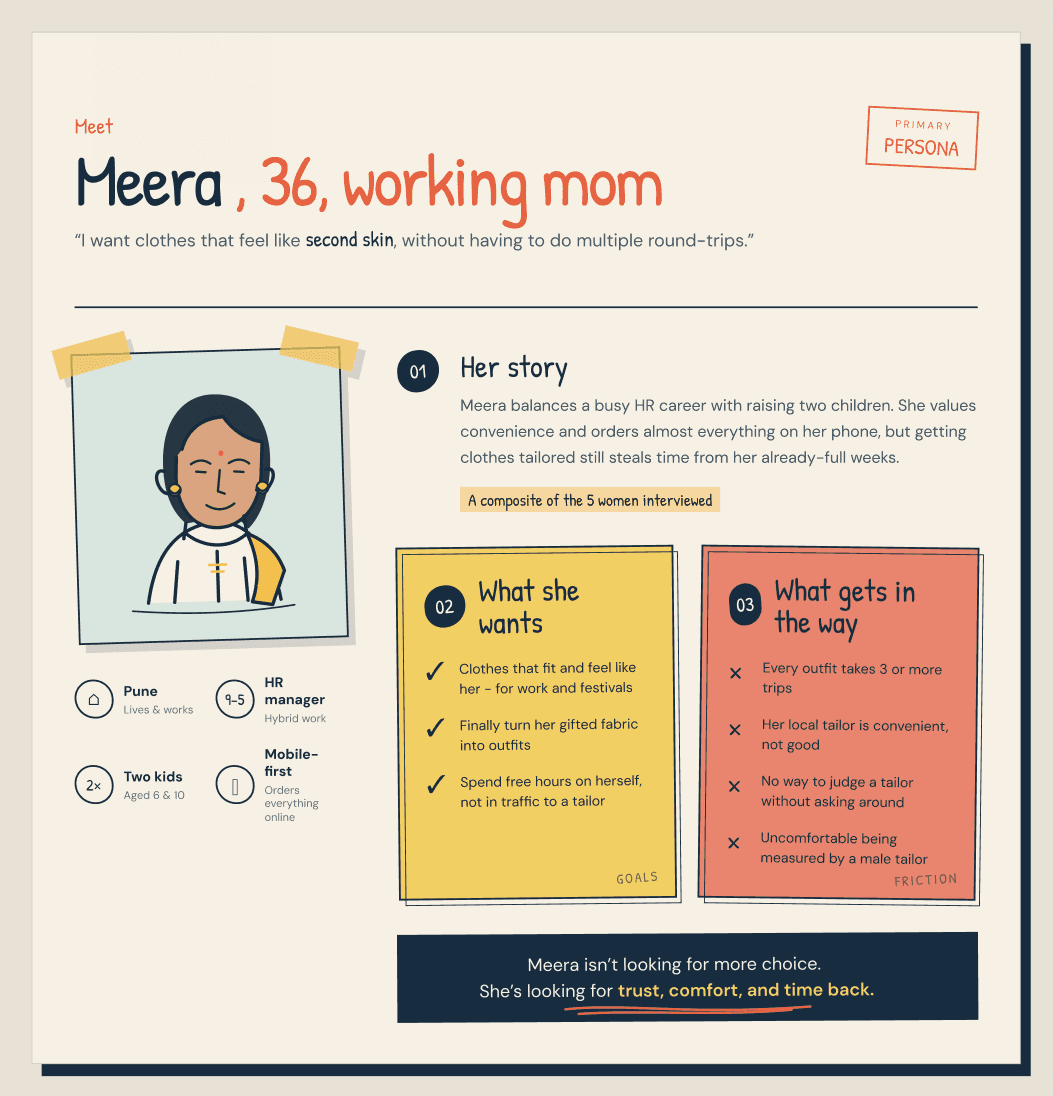
Meera is a mix of all five women. Every frustration on her sheet comes from a theme that came up again and again.
- →Multiple round-trips
is the strongest theme, so it is her top frustration. - →Convenient, not good
covers fit and trust. She picks the nearest tailor because she can't judge the others. - →Mobile-first
she orders everything else on her phone. Tailoring is the one task that still needs her to go in person, again and again.
She's looking for time back.
The core friction
One outfit and a lot of pain!
One outfit needs at least three trips. Each trip means travel, waiting and explaining again. If she misses one, the fabric goes back in the cupboard.
Fabric, lining and buttons. Often a second trip if something is missing.
At the shop, usually by a male tailor.
There's no trial room, so she tries it at home and goes back for every fix.
Meera's journey
Outfit desperation
Diwali is 2 weeks away. She wants her silk kurta stitched soon. Two steps hurt the most: getting measured and going back for alterations.
Design Requirement
Fewer trips is the feature
It's failing because every step needs another trip, another person to trust, and time these women don't have.
What I realisedChoosing a tailor, measuring and buying material all move into the app.
So I set one ruleBeyond Target Groups
Clothing means dignity to a lot of people.
Once I understood Meera's pains, I saw them everywhere. Many more people face the same problems, and often extra ones too.
This is the secondary group: people who can't find ready-made clothes that fit, and who find the tailor's shop hard to reach, hard to talk to, or uncomfortable.
This is an opportunity to address accessibility to choice.
Students, shift workers and caregivers, not only working moms.
Like Meera: repeat trips. Also: shop hours clash with work.Older adults, people with disabilities, and people who are pregnant or recovering.
Like Meera: repeat trips. Also: every trip is physically hard, and fittings mean standing.Petite, tall, plus-size and post-pregnancy bodies.
Like Meera: picks distance over quality. Also: ready-made clothes never fit, so custom is the only option.People who speak a different language from the tailor, can't sketch the design, or are deaf or hard of hearing.
Like Meera: no way to trust a tailor. Also: the design gets lost in translation.Body-conscious people, women who don't want a man to measure them, and trans and non-binary people.
Like Meera: uncomfortable being measured. Also: many skip the tailor completely.They all fall back on fast fashion, because it's the only option that doesn't need a trip.
What they all need: custom clothes without the trips.Why it matters beyond convenience
When the tailor disappears, fast fashion fills the gap
A tailored outfit is made once, worn for years, altered and handed down. Fast fashion is made in bulk, worn a few times and then thrown away. So keeping tailoring alive is good for the planet, not just convenient.
of global greenhouse gas emissions come from the fashion industry.
UNEPof textiles is landfilled or burned every second.
Ellen MacArthur Foundationof clothing material is recycled into new clothing.
Ellen MacArthur Foundationof textile waste is generated every year.
Niinimäki et al., 2020Entitites connected
People who do not support local artists often resort to fast fashion.
Waste doesn’t disappear. Unsold and thrown-away clothes are shipped in bales to markets like Kantamanto in Accra. What can’t be sold ends up in dumps, like those in Chile’s Atacama desert.
Meera wants clothes that fit and feel like her, without the trips, the guesswork and the awkward measuring.
Problem statement
Design direction
If it can happen at home, it should.
Reviews, photos and ratings build trust.
She enters, saves and shares her own measurements.
Give suggestions, never a blank page.
Colour-blind safe, voice search and alt text.
Fewer trips and private measuring help everyone, not just Meera.
For everyoneanalysis
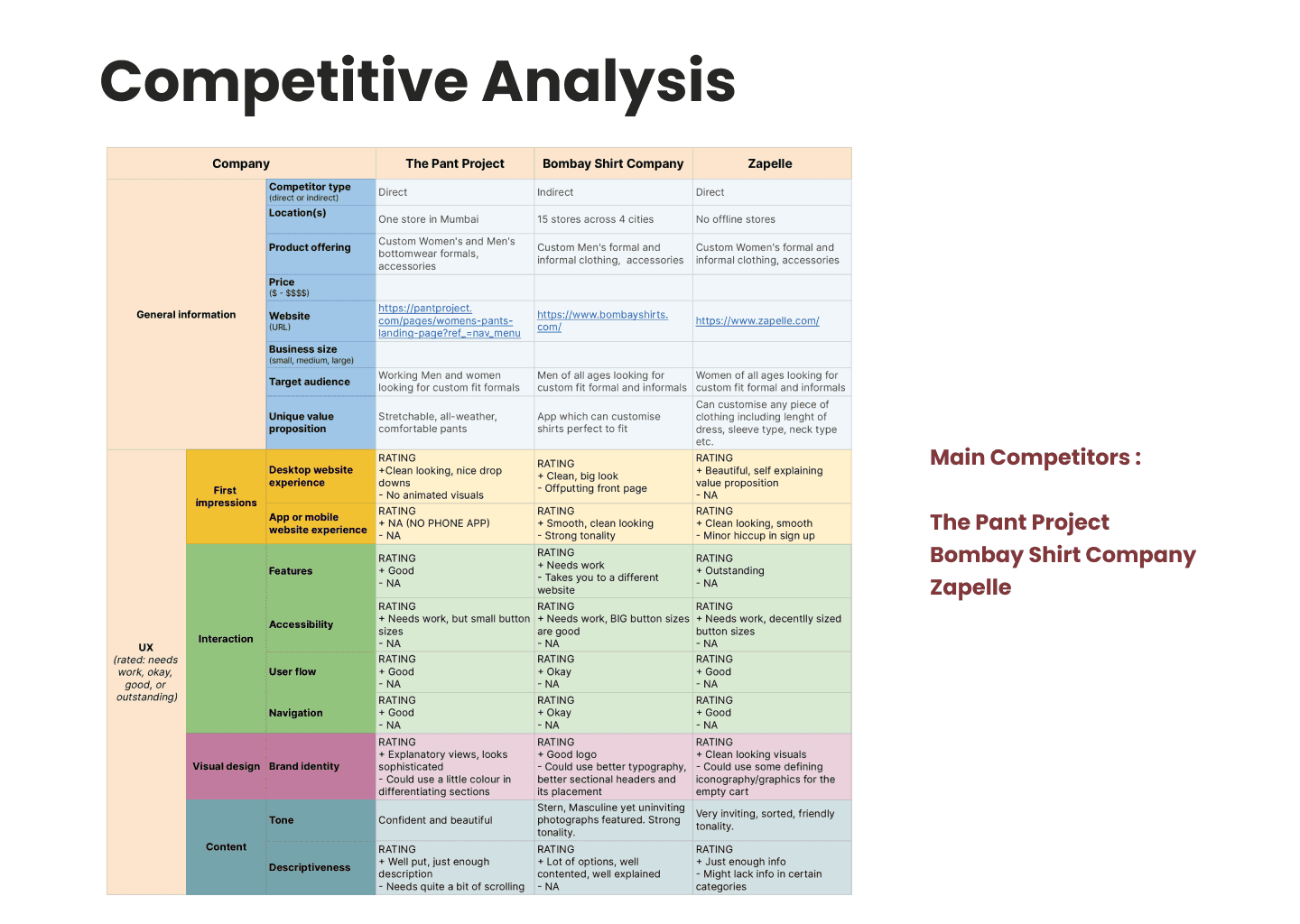
Competitors don't sell access.
Indian custom clothing brands like The Pant Project, Bombay Shirt Company and Zapelle show that people will pay for a good fit.
This will still not solve for users who want/need custom fitting clothing. None of them are built for people who can't easily travel or measure themselves.
Gaps TailorMade fills
Add profiles, past work and reviews.
Trust is in the brand, not in any tailor.Support kurtas, blouses and salwar suits.
Competitors focus on basic menswear.Guide her, save her sizes, or offer a home visit.
They all expect her to measure herself correctly.Voice search, colour-blind options and alt text.
No one in this space has it.Connect people with local tailors instead.
Brands cost much more than a local tailor.Let her send the fabric she already has.
Fabric is already waiting at home.Ideate and structure
From four sketches to one clear path
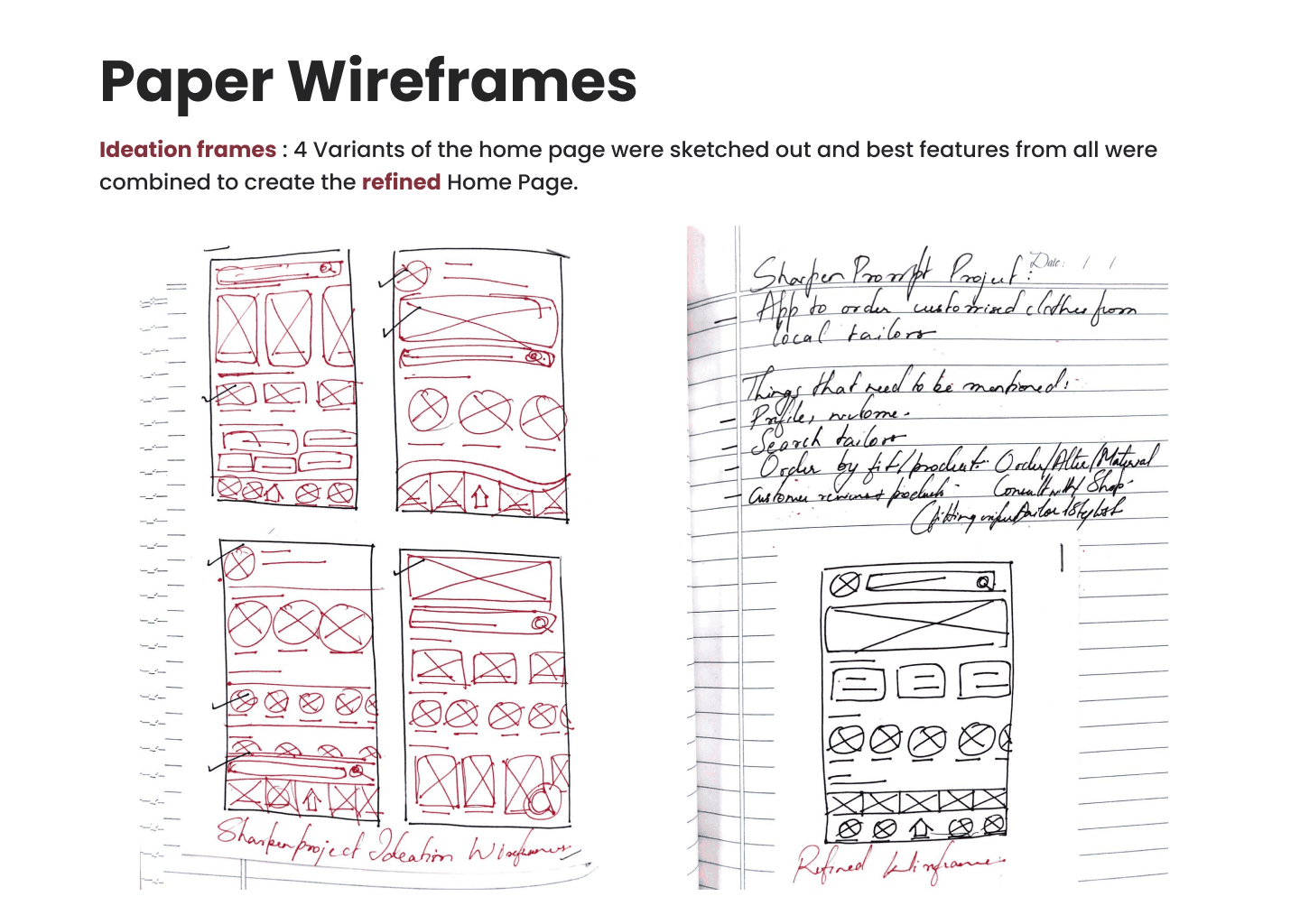
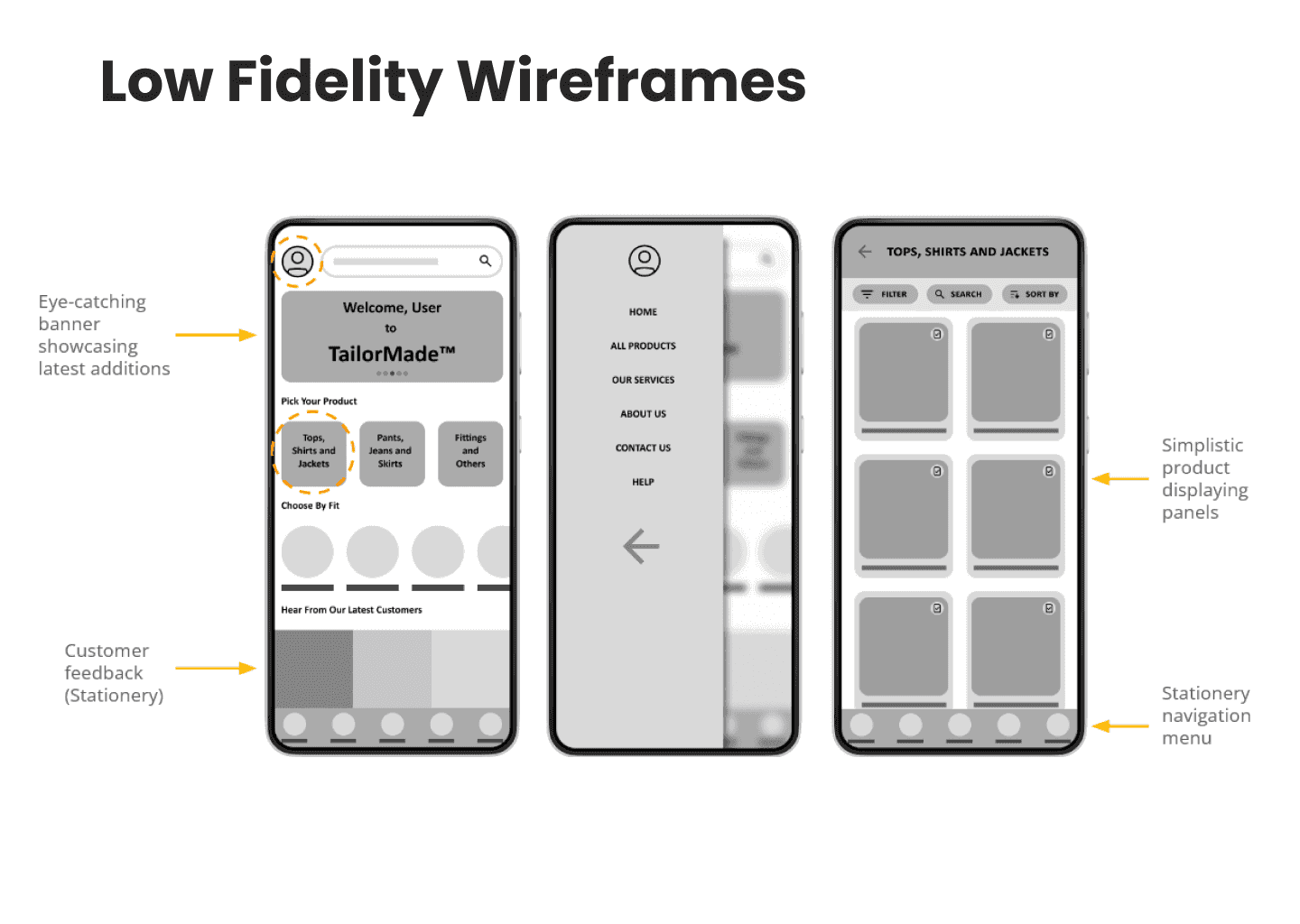
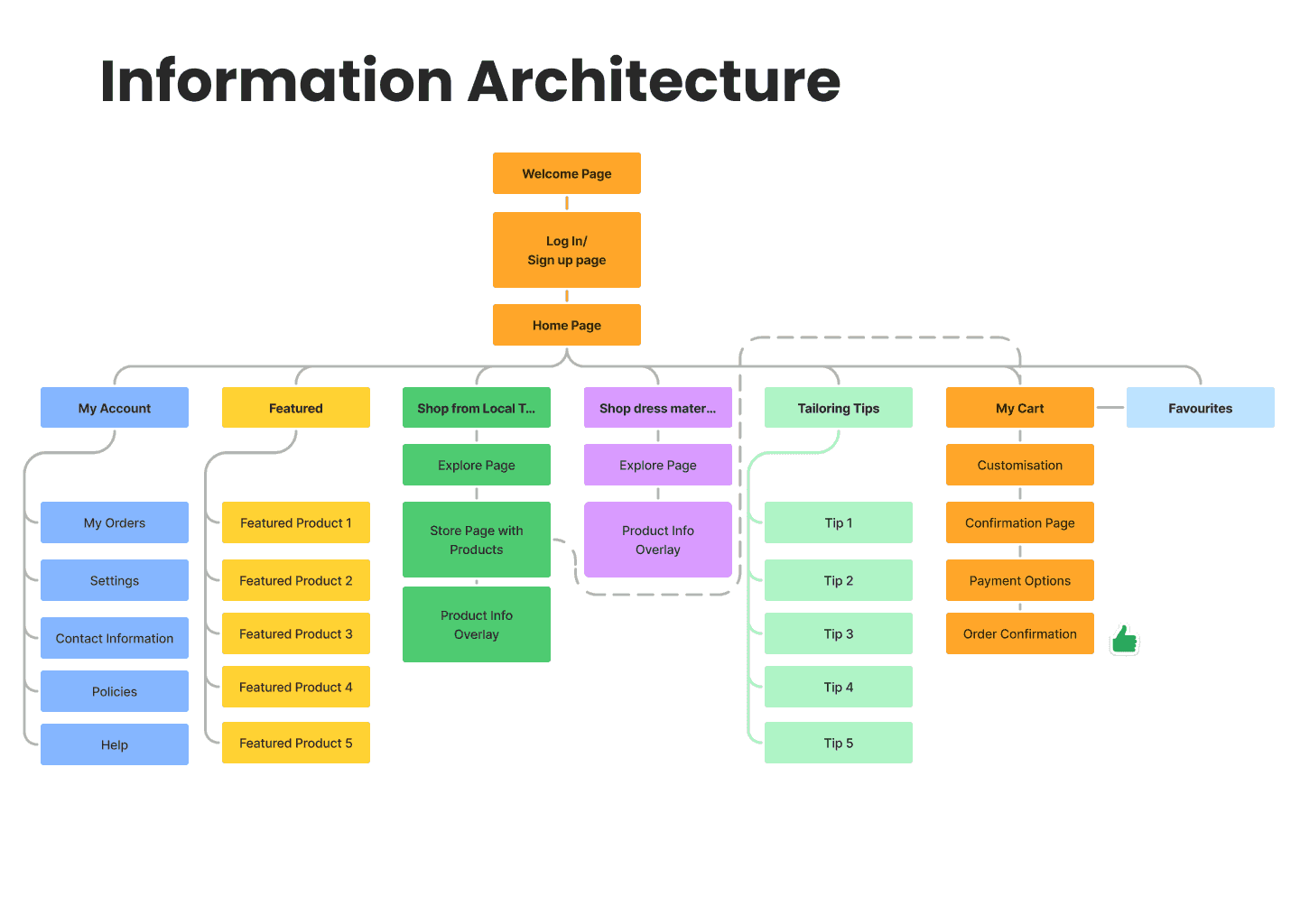
I started with the home screen, since every visit begins there. Each step made it simpler, until the main task, shopping from local tailors, was one tap from home.

Design
A brand that feels like a fabric swatch book
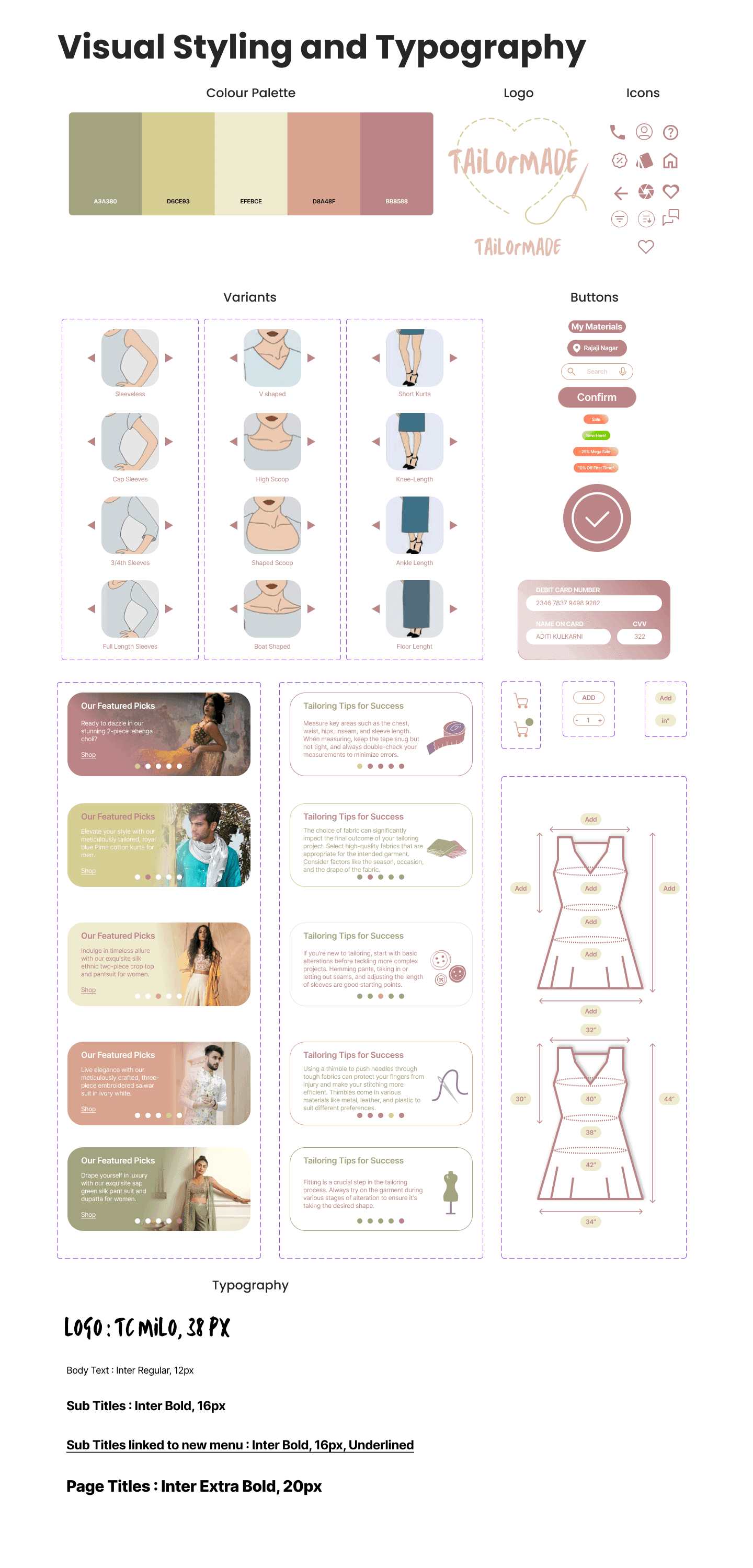
Logo, colours, type, icons, buttons, banners and custom controls, all in one system so every screen looks consistent. The sage, gold, blush and rose colours feel like a fabric swatch book, not a fast-fashion app.
Testing confirmed it: the warm, handmade feel suits choosing a personal tailor.
Final prototype
One kurta, start to finish, without leaving home
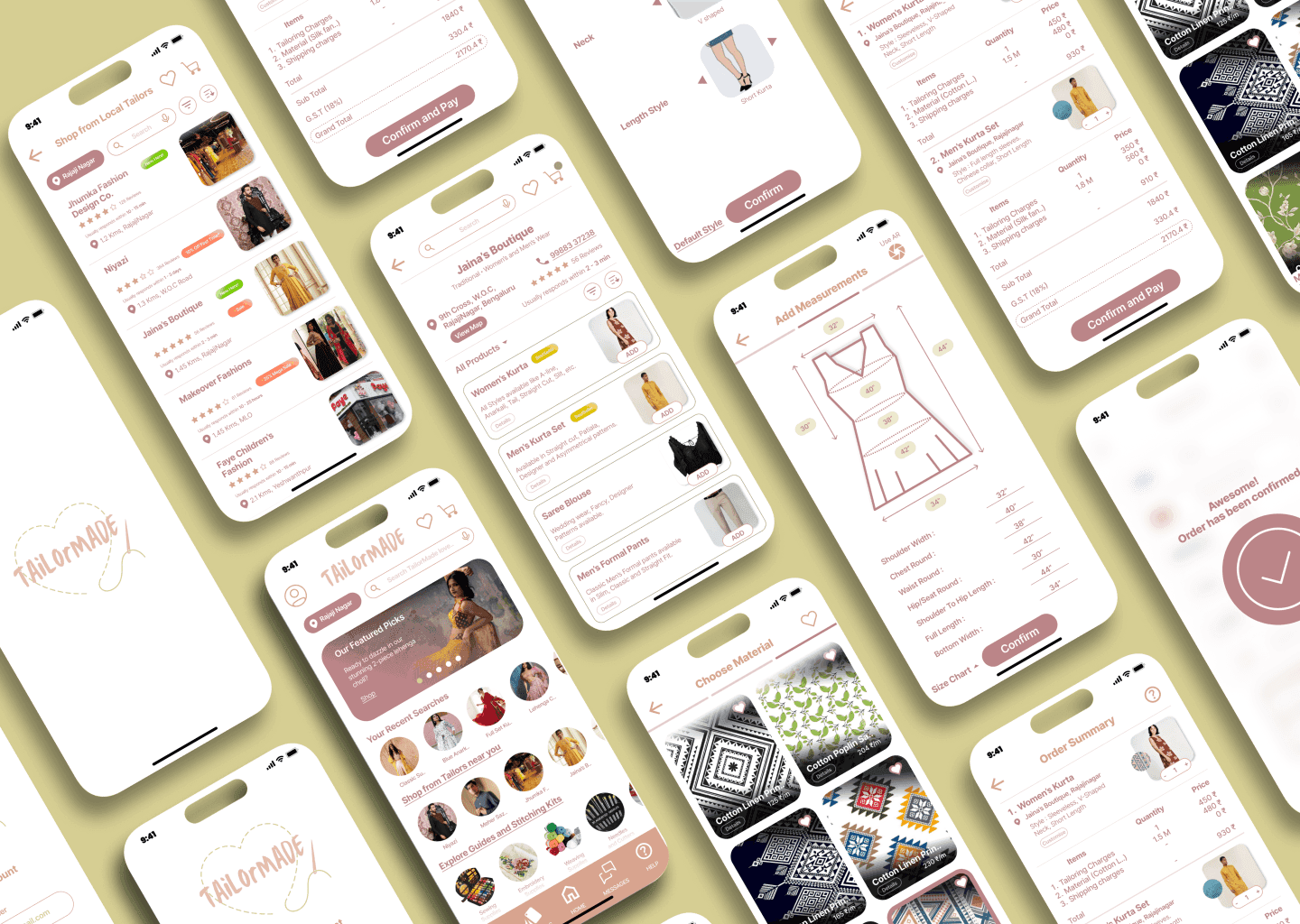
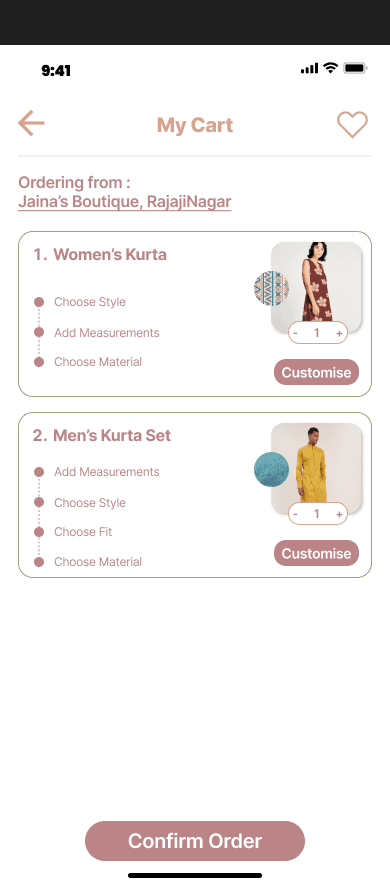
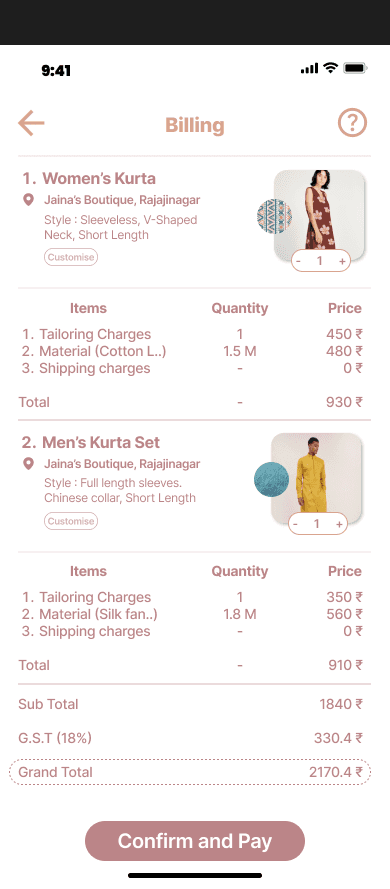
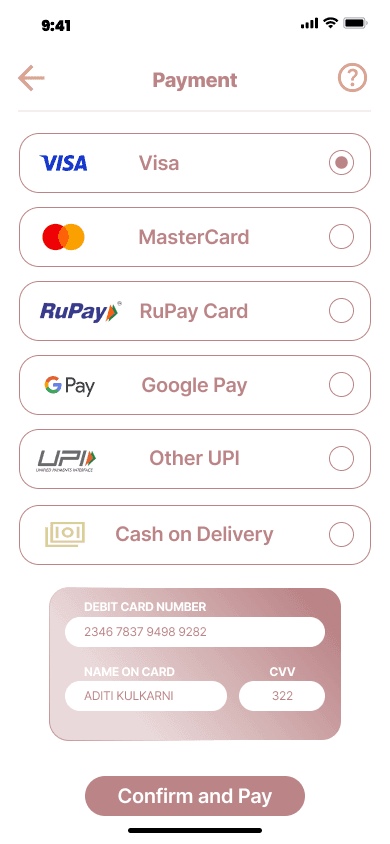
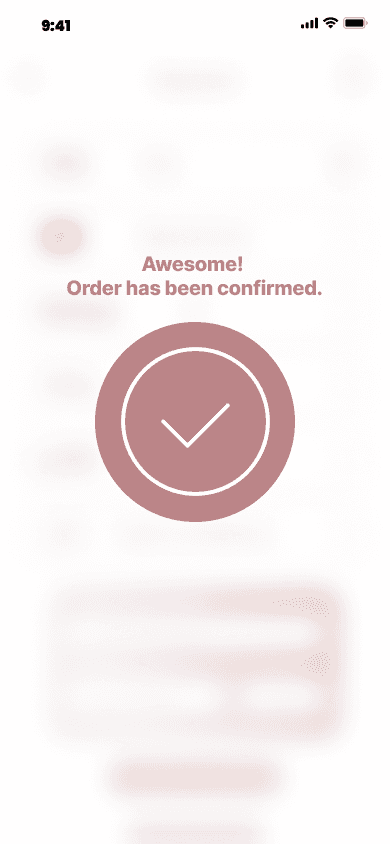
Follow Meera from the first screen to a confirmed order. She gets a kurta in her own measurements and chosen material, from a tailor she picked because of their reviews. Use the arrows to go at your own pace.
Splash
TailorMade opens with its promise: custom tailoring, without the trips.


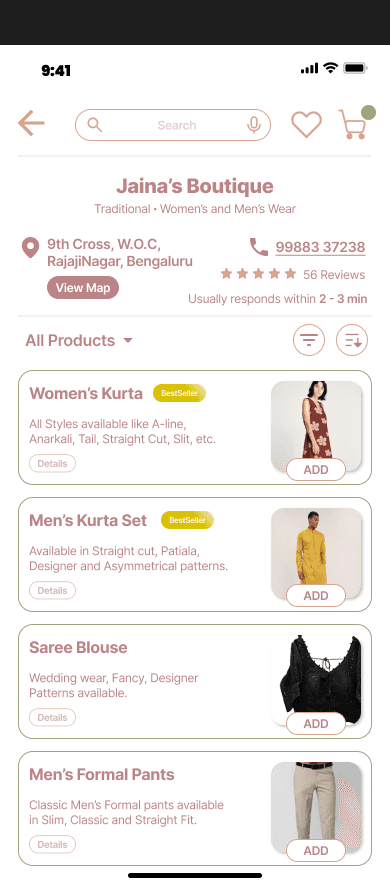
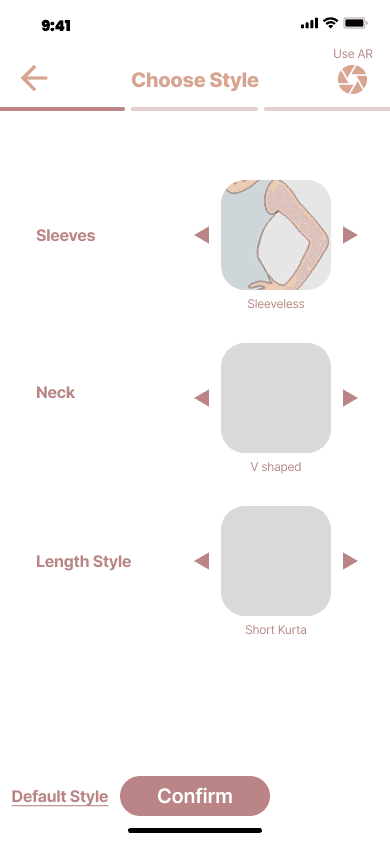
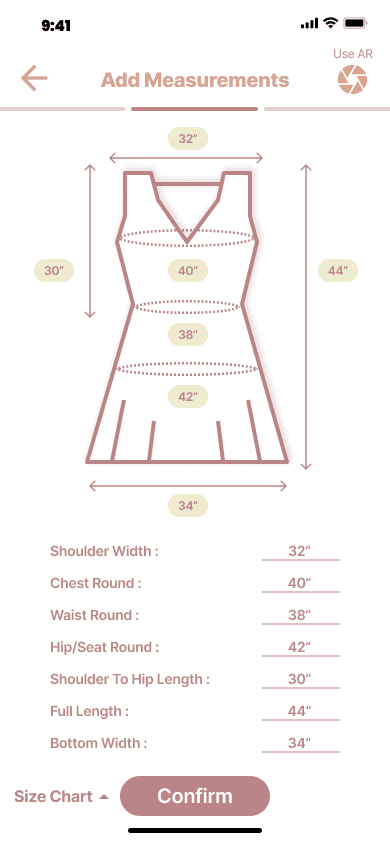
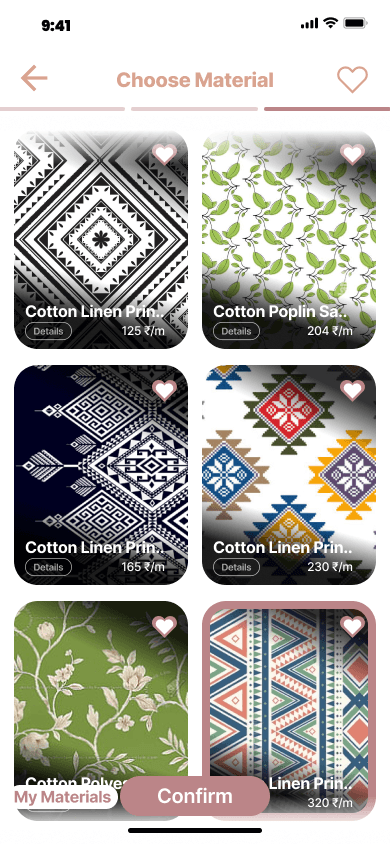
High-fidelity screens
Every screen, end to end
The full set, from the splash screen to the confirmed order: sign in, home, tailor store, style, measurements, material, cart, billing and payment.

User testing
Easy to browse, harder to finish
I ran usability tests with 6 people on the hi-fi prototype: 4 from the main audience and 2 from the secondary group. Each person did 4 tasks and rated how hard each one felt, from 1 (easy) to 5 (hard).
Clear menu names helped people find their way.
Choose a tailorSmooth, but the cart status could be clearer.
Add to cartThe hardest task: too many steps in one place.
Style, fit, measure, materialThe bill felt crowded, and there was no address check.
Place the orderReflection
This was my first project, before any work experience, as a self-taught designer
When I look back at it, I see how much more I could do with this case study.
What's next
She measures herself with guidance, or books a woman to measure her at home.
ComfortMeasure with the phone's built-in tools.
FitFor alterations, with a fit guarantee.
TripsTake photos of unstitched fabric and get style ideas.
The cupboardColour-blind mode, alt text and voice search.
EveryoneTake old outfits back to the same tailor to alter or remake them.
SustainabilityThank you for reading!
Goal: get the fabric out of the cupboard, and keep one more outfit out of the dump.